This is where affordable table styling becomes less about price and more about proportion.
A table does not need a different plate for every occasion. It needs a foundation that can be dressed differently when the occasion changes.
A neutral setting also makes it easier to introduce seasonal elements without replacing the entire tableware collection. Greenery, fruit, candles, or a different napkin can change the atmosphere while the basic dinnerware remains the same.
Use Linen to Soften Hard Surfaces
Wood, ceramic, glass, and metal are all relatively hard materials. Without something softer, a table can sometimes feel visually rigid.
Linen provides that softer layer.
The natural napkins used here are intentionally uncomplicated. Their slightly relaxed appearance keeps the table from becoming overly formal, while their texture adds visual interest close to each guest.
The same principle applies to the table runner.
Rather than selecting a highly decorative textile, a simple natural runner can establish a visual path through the center of the table. It creates a transition between the individual settings and the centerpiece without competing with either.
For a more affordable approach, there is no need to coordinate several different textiles. One natural fabric repeated across the table is often enough.
The key is choosing texture over decoration.
A slightly rumpled linen napkin can look more sophisticated than a perfectly pressed synthetic textile when the rest of the table has a natural character.
Choose a Centerpiece That Does Not Need to Be Expensive
The centerpiece is often where table styling becomes unnecessarily expensive.
A large floral arrangement may be beautiful, but it is not the only way to create a focal point.
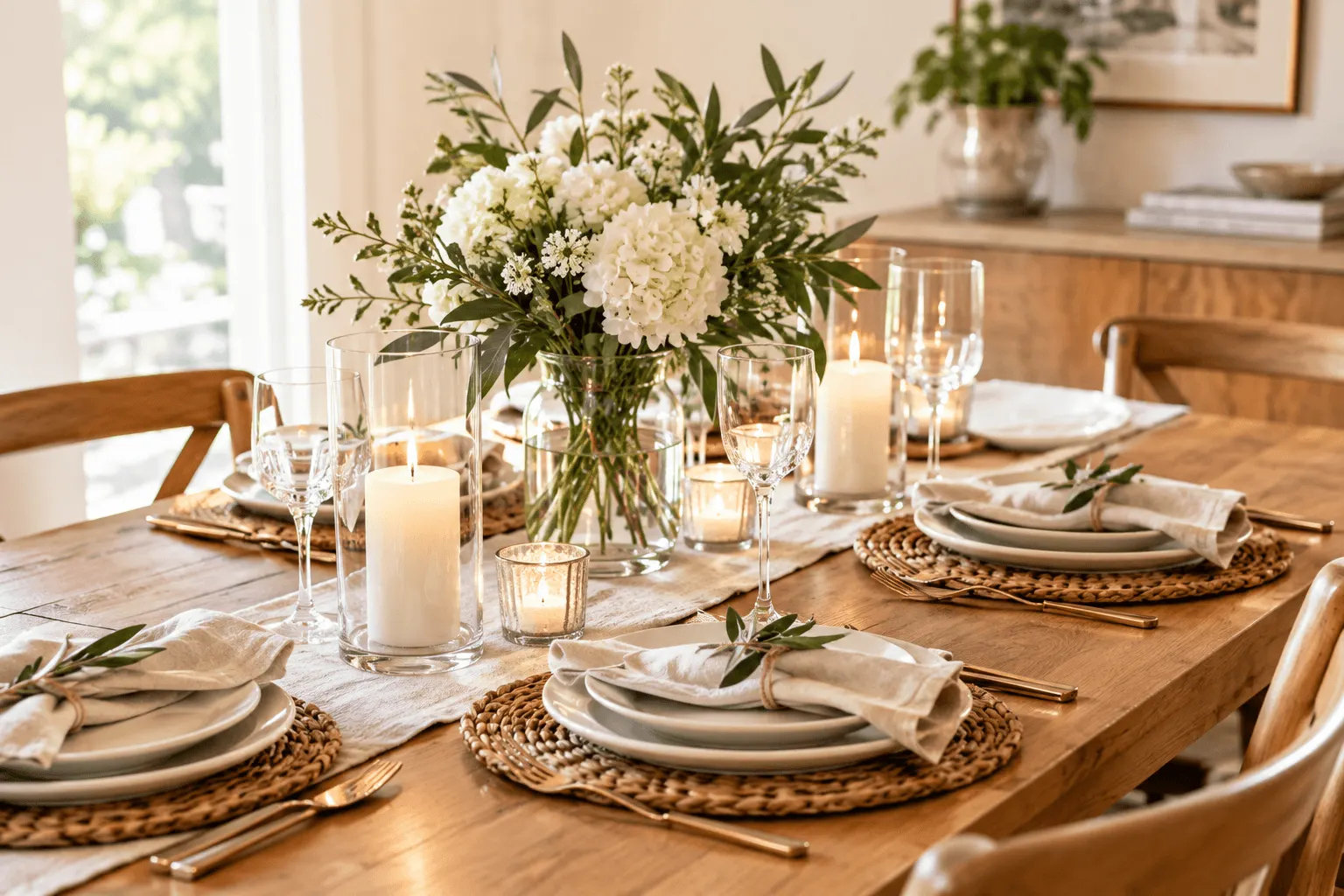
This table uses a generous arrangement of greenery and white flowers, but the underlying principle can be simplified considerably. A smaller arrangement of seasonal branches, foliage, or locally available flowers can create the same sense of freshness.
The important part is shape and placement, not quantity.
A centerpiece should have enough presence to anchor the table but remain low enough that guests can see across it. It should also leave enough open space around the individual place settings.
For a more budget-conscious interpretation, consider:
- seasonal greenery from the garden;
- a few branches arranged in a simple vessel;
- one compact floral arrangement instead of several;
- foliage combined with a small number of flowers;
- a simple glass vase already owned.
The vessel itself does not need to become a decorative statement. In many cases, transparent or neutral containers allow the natural materials to remain the focus.
Think about volume before buying more
If a centerpiece looks sparse, the first instinct may be to add more flowers. Sometimes the better solution is simply to change the arrangement.
Branches can create height and movement. Foliage can provide volume. A few flowers can then become focal points rather than filling every space.
This creates a more natural composition and can substantially reduce the number of stems required.
Add Candlelight Instead of More Decorations
Candles are another example of an element that can perform several jobs at once.
They provide light, warmth, vertical interest, and atmosphere. During an evening meal, their glow can become part of the table’s decoration without requiring additional accessories.
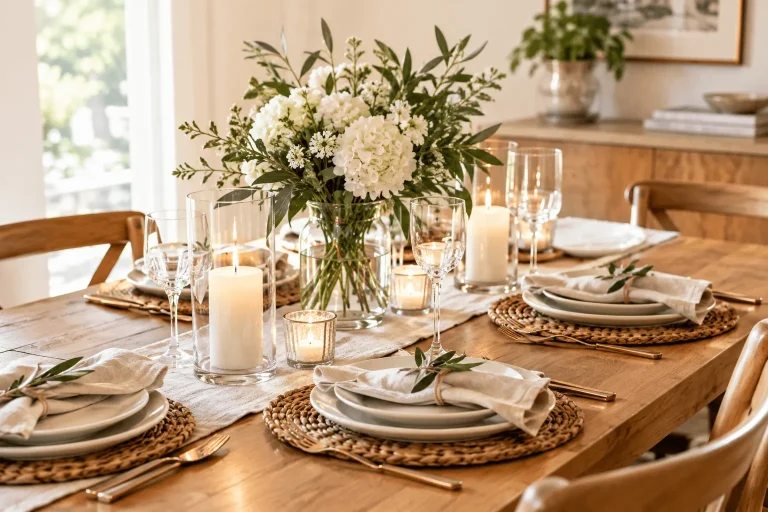
The table shown here uses different candle heights. Taller candles create vertical rhythm, while smaller candles closer to the surface create points of light between the settings.
That variation is more interesting than placing identical candles at perfectly equal intervals.
For affordable table styling, there is also no need to cover the entire table with candleholders. A few carefully positioned candles can have more impact when there is enough open space around them.
Glass candleholders can be particularly useful because they maintain visual lightness. They allow the candle flame to remain visible without introducing another strong color or material.
The broader lesson is simple: decorative elements become more valuable when they also contribute to the experience of the meal.
Keep Glassware Simple and Transparent
Glassware can easily make a table appear more elaborate than it actually is.
Clear glasses are particularly effective because they add height and reflection without introducing another visual color. They allow the greenery, linen, and wood to remain visible through the setting.
The table here combines clear stemware with additional transparent glasses. Although the arrangement feels considered, the transparency keeps the overall composition light.
There is also an important practical advantage to simple glassware: it can work with many different table settings.
Rather than purchasing specialty glasses for a single occasion, a versatile clear set can move between everyday meals and holiday entertaining.
When the table already contains several textures — woven fibers, wood, linen, ceramic, greenery, and candles — transparency prevents the composition from becoming visually dense.
Let Gold or Metal Accents Stay Small
Metallic details can make a simple table feel more polished, but they do not need to dominate the setting.
The warm gold-toned flatware in this composition adds a subtle point of refinement against the natural wood. Because the plates, napkins, and centerpiece remain relatively quiet, the metal feels like an accent rather than a theme.
This is an effective approach when working with an existing tableware collection.
Instead of replacing every piece, introduce one small repeated finish.
It could be:
- warm metal flatware;
- a simple candleholder;
- a napkin ring;
- a small decorative accent.
The important point is repetition. One metallic detail may look accidental. A finish repeated two or three times throughout the table becomes part of the visual language.
At the same time, there is no need to introduce several different metallic finishes. Keeping the metal consistent makes the table feel more deliberate.
Use Greenery to Connect the Table With the Room
A table rarely exists in isolation.
The surrounding room contributes to how the setting feels, particularly when the dining area already contains natural wood, greenery, artwork, or architectural details.
The centerpiece here uses foliage to create a connection between the dining table and the greenery visible elsewhere in the room. This makes the arrangement feel integrated rather than placed on the table as an isolated decoration.
The same principle can be used without buying additional décor.
Look around the dining room before styling the table.
If the room already contains:
- natural wood;
- green plants;
- woven materials;
- neutral upholstery;
- warm lighting;
the table can repeat one or two of those characteristics instead of introducing a completely new palette.
That repetition creates cohesion without requiring more objects.
Leave Some Space Empty
One of the most overlooked parts of elegant table styling is the space that is deliberately left undecorated.
When every section of a table is filled, individual pieces lose their visual importance. The centerpiece becomes harder to read, the place settings feel crowded, and guests have less practical room.
Open areas give the eye somewhere to rest.
This is especially important when using a substantial centerpiece. The arrangement may provide the main visual interest, but it should not consume the entire center of the table.
The same applies to each place setting.
There is no need to surround a plate with decorative objects simply because there is room for them. The plate, napkin, flatware, and glassware already establish the setting.
Restraint is one of the least expensive styling tools available.
Make One Element the Focal Point
An affordable table can still feel sophisticated when there is a clear visual hierarchy.
In this composition, the eye moves naturally between the centerpiece, the neutral place settings, the greenery, and the warm candlelight. No single accessory needs to carry the entire table.
This is useful when working with a limited budget.
Instead of asking, What else can I add?, ask:
What should the eye notice first?
If the answer is the centerpiece, keep the place settings quieter.
If the dinnerware is the strongest element, use simpler textiles and decoration.
If the table itself has beautiful wood grain, allow more of the surface to remain visible.
This approach prevents the common mistake of trying to make every element equally important.
Style the Table With What You Already Own
Before shopping for a new table setting, gather the pieces already available in the home.
Place the dinnerware, glasses, flatware, textiles, candles, and decorative vessels together. Then look for what is missing rather than automatically buying a complete collection.
Often, the table needs only one or two additions.
Perhaps the existing dinnerware needs texture, so woven placemats solve the problem. Perhaps the table feels too neutral, so greenery introduces contrast. Perhaps the composition lacks warmth, so candlelight changes the atmosphere.
This method is not only more affordable; it usually produces a more personal result.
A table assembled entirely from matching pieces can look polished, but a table that combines familiar materials often feels more natural and lived-in.
A simple editing test
Before considering the table finished, remove one decorative element.
Then look again.
If the composition feels cleaner without it, leave it off.
If something important disappears, return it.
This small exercise can help prevent overdecorating and often improves the balance of the table without costing anything.
Affordable Table Styling Can Still Feel Special
The most successful affordable tables are not trying to disguise a limited budget. They simply prioritize the elements that have the greatest visual impact.
Natural wood provides the foundation.
Neutral dinnerware creates flexibility.
Woven textures add depth.
Linen softens the setting.
Greenery brings life.
Candles provide warmth.
Clear glassware keeps the composition light.
A small amount of metal adds refinement.
Together, these elements demonstrate that sophistication does not require an abundance of decorative objects.
The table becomes elegant because the materials are balanced and the composition has room to breathe.
Final Thoughts
Affordable table styling works best when the goal is not to make a table look expensive, but to make every element feel intentional. A natural wood surface, simple dinnerware, textured linen, greenery, transparent glassware, and a few candles can create a setting that feels complete without becoming complicated.
The most useful change may be a change in approach: start with what already exists, identify the one or two areas that need more texture or warmth, and resist adding anything that does not improve the composition. When materials are allowed to speak for themselves and empty space remains part of the design, even a simple table can feel thoughtful, welcoming, and elegant.
You may also like
Takeaway
Elegant table styling does not depend on quantity. Start with natural materials, repeat a small number of finishes, introduce texture, and use light to create atmosphere. The result can feel considered and welcoming while remaining practical and attainable.