
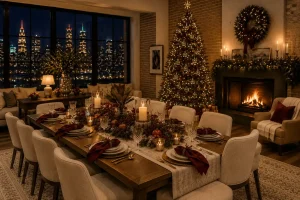
A beautiful Christmas dinner table does not need to feel overly formal or heavily decorated. Some of the most inviting holiday tables rely on a restrained palette, warm candlelight, natural greenery and a few carefully chosen details that make the setting feel special without becoming theatrical.
This approach works especially well for a Christmas dinner because the atmosphere is created as much by the surroundings as by the table itself. A glowing fireplace, a decorated Christmas tree, evening light through the windows and reflective glassware can all become part of the setting.
When these elements are balanced thoughtfully, the result feels elegant but comfortable — a table where guests can settle in, linger over dinner and enjoy the evening rather than feel as though they are sitting in a display.
- Warm materials can make an elegant table feel more inviting.
- Candlelight adds atmosphere without requiring excessive decoration.
- Deep Christmas colors can be introduced through small, controlled details.
- Natural greenery keeps the composition connected to the season.
- Layered dinnerware and glassware create refinement while remaining practical.
Start With the Atmosphere Around the Table
A Christmas dinner table rarely exists on its own. The room surrounding it can have as much influence on the final impression as the place settings themselves.
In a nighttime setting, warm architectural elements become particularly important. A fireplace, a Christmas tree illuminated with small lights and windows revealing the evening outside create layers of visual depth behind the table.

This is one reason a dinner table can feel warmer when the decoration is relatively restrained. The room is already contributing to the story.
Instead of covering every surface with Christmas decorations, allow the architecture to remain visible. The table then becomes part of a larger holiday composition rather than an isolated centerpiece.
For a modern home, this can be especially effective. Neutral walls, natural wood, contemporary furniture and warm lighting provide a quiet backdrop for richer seasonal details.
Let the Christmas Tree Become Part of the Setting
A Christmas tree positioned within the visual field of the dining table can provide an immediate sense of occasion.
There is no need for the tree and table to match perfectly. They simply need to share one or two visual connections.
For example, if the table incorporates deep red or burgundy accents, those colors can appear subtly in the tree ornaments. If the table uses warm metallics, the tree lights can provide a similar glow.
The goal is continuity rather than repetition.
Build Warmth With Wood and Natural Materials
One of the easiest ways to prevent an elegant Christmas dinner table from feeling cold is to introduce natural texture.
Wood is particularly effective because it absorbs and softens the light rather than reflecting it strongly. A wooden dining table can therefore become the visual foundation for glass, porcelain, metal and candlelight.
Natural materials can also make a formal table feel more connected to everyday living.
A woven element, linen napkin or natural greenery can be enough to create this effect.
The important point is balance. If every element has a strong texture, the table can quickly become visually busy. Choose one or two natural materials and allow the finer elements of the setting to provide contrast.
| Element | What it contributes | Best used for |
|---|---|---|
| Natural wood | Warmth and visual stability | Tabletop or serving pieces |
| Linen | Softness and relaxed elegance | Napkins and textiles |
| Greenery | Seasonal freshness | Centerpiece and place settings |
| Cut glass | Light and refinement | Wine and water glasses |
| Warm metal | Subtle luminosity | Flatware and candleholders |
This combination creates a useful design principle for Christmas dinner tables: combine something warm, something reflective and something natural.
That contrast is often more effective than adding more decoration.
Layer the Place Setting Without Making It Formal
A sophisticated Christmas dinner table usually benefits from several layers at each place.
Start with the base, then build upward through the dinnerware and textile elements.
A charger or woven placemat establishes the visual boundary of each setting. Dinner and salad plates can then create depth, while a folded linen napkin introduces softness.

The arrangement should still leave enough practical space for the guest to eat comfortably.
This matters because an elegant table can easily become too decorative. When plates, candles, flowers and accessories compete for the same limited surface, the setting may photograph beautifully but become uncomfortable during dinner.
A better approach is to make every decorative decision serve the table.
The napkin, for example, can become part of the styling simply through its fold. A small branch of greenery or understated napkin ring can add a seasonal detail without requiring another ornament.
Use the Napkin to Introduce Christmas Color
Deep red, burgundy or cranberry tones are particularly effective for Christmas because they bring seasonal color without overwhelming a neutral setting.
You do not need red plates, red runners and red flowers simultaneously.
A single textile element can be enough.
A burgundy napkin against ivory dinnerware, for example, creates a strong contrast while keeping the majority of the place setting quiet.
This is an especially useful technique when the room already contains Christmas decorations.
If the room is visually rich, keep the place setting restrained. If the room is neutral, allow the table to carry slightly more seasonal color.
That simple adjustment can prevent the decoration from feeling excessive.
Choose Glassware That Works With Candlelight
Glassware becomes particularly important during a Christmas dinner because evening lighting changes the way the table is perceived.
Cut or textured crystal catches candlelight and creates small reflections across the tabletop. These reflections add movement without introducing additional colors or objects.
This is one of the reasons glassware can contribute so much to an elegant Christmas dinner table.
Instead of choosing decorative glasses that compete with the dinnerware, look for shapes and textures that interact with light.
Two or three glass pieces per setting can be enough, depending on the meal. Wine glasses can be paired with water glasses, while a smaller glass can be added when appropriate.

The key is proportion.
Tall glasses create vertical rhythm, but too many tall pieces can interfere with conversation across the table. Place taller glassware where it contributes to the composition without creating a visual wall between guests.
Create a Centerpiece That Feels Abundant but Controlled
The centerpiece is often the most difficult part of a Christmas dinner table.
Too little greenery can make the table feel unfinished. Too much can make it difficult to see across the table.
The most successful arrangements tend to occupy the horizontal space rather than building one enormous structure in the center.
Greenery can run along the length of the table, with flowers, berries or seasonal branches introduced selectively.
This creates a sense of abundance while preserving the practical function of the dining table.

For a warm and elegant Christmas setting, consider combining:
- evergreen or leafy branches;
- deep red berries;
- ivory or cream flowers;
- natural branches;
- small candles;
- understated metallic accents.
The arrangement does not need to look perfectly symmetrical.
In fact, slight variation can make the table feel more natural and less like a staged showroom.
Keep the Center Low Enough for Conversation
One practical test can help determine whether a centerpiece is working.
Sit at the table.
Look directly across at another place setting.
If the arrangement blocks the face of the person opposite you, it is probably too tall.
This is one of those small design decisions that has a surprisingly large effect on the experience of the dinner.
A beautiful Christmas table should encourage conversation, not interrupt it.

Use Candlelight to Make the Table Feel Warmer
Candles are one of the most effective tools for changing the atmosphere of a Christmas dinner table.
Their value is not simply decorative. Candlelight changes the quality of the entire room.
It softens hard surfaces, creates reflections in glassware and gives natural materials a warmer appearance.
Instead of using candles only in the center, distribute several small points of light along the table.
Tall candles can establish vertical rhythm while lower votives create a layer of light closer to the tabletop.

The combination is often more atmospheric than using only one candle style.
Mix Heights, Not Every Possible Style
A common mistake is to introduce too many different candleholders.
A better approach is to select two related forms.
For example:
- tall tapered candles for height;
- small glass votives for low-level glow.
The flames then appear at different levels without making the tabletop visually complicated.
This is another example of restraint creating sophistication.
Bring in Deep Christmas Colors Carefully
Warm and elegant does not mean that the table has to be entirely neutral.
Christmas is an opportunity to introduce deeper seasonal colors, particularly when they are used with intention.
Cranberry, burgundy, forest green and warm brown can all work beautifully with ivory, natural wood and candlelight.
The trick is to treat these colors as accents rather than as the entire palette.
A useful proportion might be:
neutral foundation + natural greenery + one deep seasonal accent.
That could mean ivory dinnerware, green foliage and burgundy napkins.
Or it could mean a neutral table with cranberry berries and small red ornaments incorporated into the centerpiece.

The exact combination matters less than maintaining a visual hierarchy.
Make Elegant Details Feel Lived In
One of the most appealing qualities of a successful Christmas dinner table is that it should look ready for people, not simply ready for photography.
This distinction is important.
A perfectly symmetrical table can sometimes feel like a showroom. A slightly relaxed arrangement can communicate warmth.
Napkins do not have to be folded identically.
Greenery can extend naturally across the table.
Glassware can catch different reflections.
Serving dishes can appear within reach.
These small imperfections make the table feel inhabited.
For a modern home, this approach is particularly valuable because it prevents holiday decoration from becoming disconnected from the way the room is normally used.
The goal is not to create a Christmas set.
The goal is to create a beautiful version of the home people already love living in.
Balance Elegance With Practical Space
Before adding another decorative element, consider how much usable space remains on the table.
Guests need room for serving dishes, glasses, cutlery and conversation.
If the centerpiece occupies the entire middle of the table, there may be nowhere to place shared food.
This is why a long, low arrangement can be more successful than a large central floral display.
It distributes the decoration while preserving the functional areas around it.
For larger Christmas dinners, consider placing some decorative elements on a sideboard, console or nearby serving surface rather than forcing everything onto the dining table.
This creates visual continuity throughout the room and gives the table more breathing space.
The Small Details That Complete the Table
Once the main composition is established, only a few details are usually necessary.
A small branch tucked into a napkin can repeat the greenery from the centerpiece.
A cranberry-colored ornament can connect the table with the Christmas tree.

A textured glass votive can reinforce the sparkle of the crystal.
A linen napkin can soften the relationship between porcelain and metal.
These details work because they repeat ideas already present in the room.
They do not introduce entirely new visual languages.
That is an important distinction when styling an elegant holiday table: refinement often comes from repetition with variation, not from adding more objects.
A Warm Christmas Table Is About More Than Decoration
The most memorable Christmas dinner tables are rarely the ones with the greatest number of decorations.
They are the ones where the elements work together.
Warm wood creates a foundation. Ivory and cream keep the setting light. Greenery introduces nature. Deep seasonal accents provide contrast. Crystal catches the candlelight. Linen softens the place settings. And the surrounding room completes the atmosphere.
Together, these choices create a table that feels festive without becoming theatrical.
For a contemporary home, this balance can be particularly powerful. Christmas does not need to completely transform the character of the room. Instead, the holiday can be layered into the existing architecture, materials and routines.
That is what makes the setting feel authentic.
A Simple Formula for a Warm and Elegant Christmas Table
When deciding whether your table needs another element, return to four questions:
- Does it add warmth?
- Does it add texture?
- Does it improve the light?
- Does it help tell the Christmas story?
If the answer is no to all four, the table probably does not need it.
Sometimes the most elegant decision is to leave a little space.
You may also like
If you are creating a complete Christmas atmosphere throughout your home, these Decor With ideas can help you continue the same refined approach:
- Christmas Table Decoration Ideas for Every Home Style
- Christmas Table Styling Ideas Like an Interior Designer
- Christmas Breakfast Table Ideas to Start the Holiday Beautifully
Conclusion
The best Christmas dinner table setting ideas create an atmosphere that feels special without losing the comfort of a real home. Warm wood, layered dinnerware, natural greenery, crystal glassware and candlelight can transform an ordinary dining table into an elegant setting for the holiday without relying on excessive decoration.
The most important decision is not how much Christmas you can add, but how thoughtfully you can layer it into the room.
Choose a restrained palette, introduce one or two deeper seasonal accents, keep the centerpiece low enough for conversation and allow candlelight to do some of the decorating.

The result can be polished enough for a beautiful Christmas dinner while still feeling relaxed, welcoming and genuinely lived in.