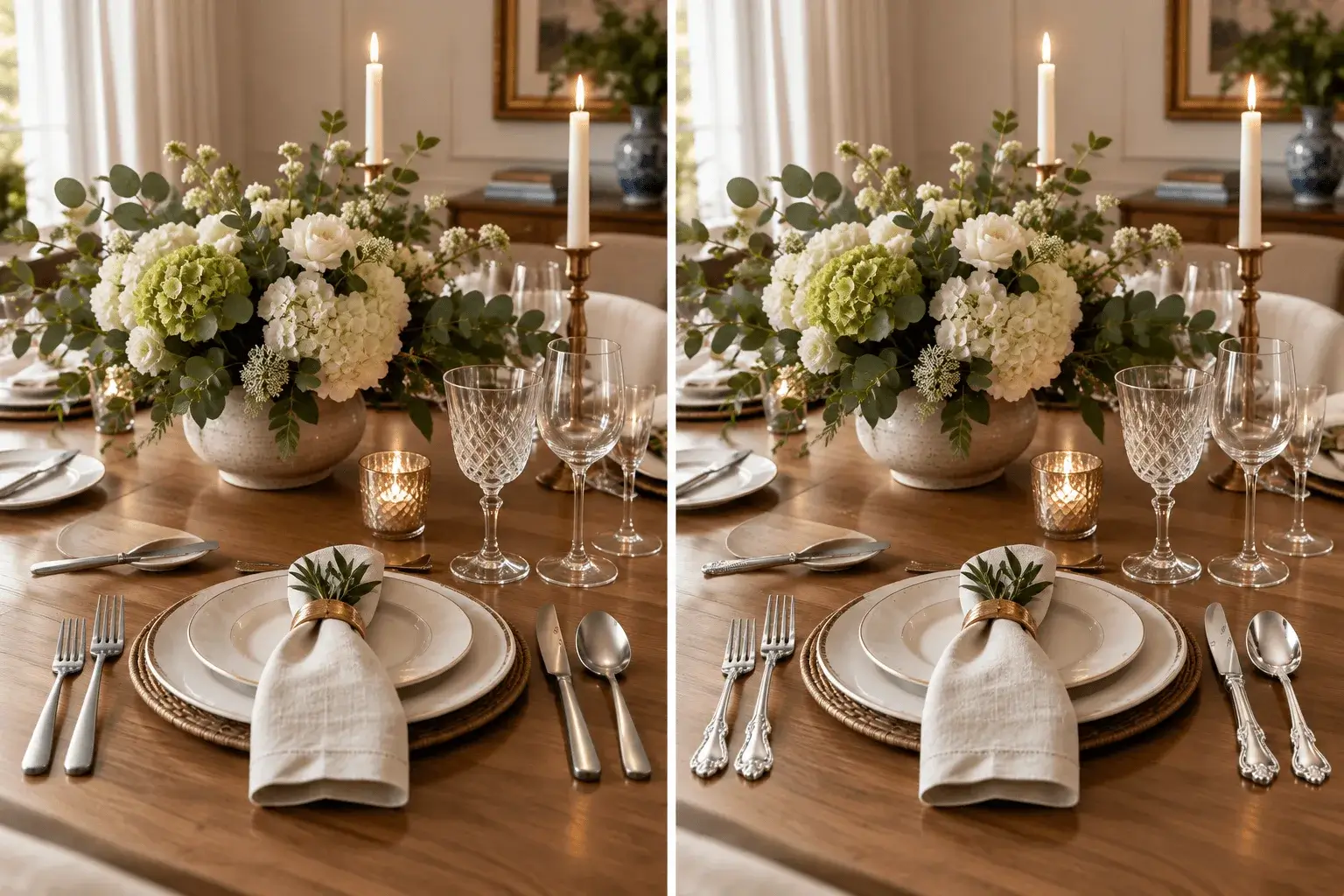
A beautifully set table does not need to be filled with decorative objects to feel special. Table styling without overdecorating is really about knowing what deserves attention, what can be left open, and how each element contributes to the experience of the meal. In the dining room shown here, a warm wood table, neutral dinnerware, natural linen, crystal glassware, candlelight, and a generous floral centerpiece create an inviting setting without competing for attention.
The difference between a table that feels thoughtfully styled and one that feels crowded is often surprisingly small. One additional centerpiece, another decorative object, or an unnecessarily elaborate place setting can change the balance completely.
The most successful approach is to think in layers: begin with the functional pieces, introduce one strong natural element, add texture and light, and then stop before the table loses its breathing room.
- Keep the table practical enough for a real meal.
- Give one or two elements visual priority.
- Use empty space as part of the composition.
- Choose texture instead of adding more objects.
- Let materials such as wood, linen, glass, and greenery provide visual interest.
What Table Styling Without Overdecorating Really Means
Overdecorating is not simply a matter of having too many objects. A table can contain several beautiful pieces and still feel restrained if they have a clear relationship with one another.
The real issue is visual competition.
When every part of the table asks to be noticed at the same time, the eye has nowhere to rest. Decorative plates compete with elaborate napkins. A tall centerpiece blocks the conversation. Too many candles create a forest of objects. Multiple colors fragment the composition.
A restrained table works differently. There is usually a hierarchy.
The dinnerware establishes the place setting. The centerpiece provides the central visual movement. Glassware introduces transparency and reflection. Linen softens the harder materials. Candlelight changes the atmosphere as the meal progresses.
Everything has a purpose.
Designer Insight: Restraint is not the absence of decoration. It is the ability to decide which decoration matters most.
This distinction is especially useful when decorating a dining table at home. Instead of asking, What else can I add?, ask, What is missing from the experience?
If the table already has strong dinnerware, perhaps it needs softness rather than another decorative object. If the centerpiece is visually generous, perhaps the place settings should become quieter.
That small change in thinking is often enough to prevent a table from becoming visually overloaded.
Start With the Table Itself
One of the easiest ways to avoid overdecorating is to allow the dining table to remain visible.
In the photographed setting, the warm wood surface becomes part of the decoration. Its natural grain provides variation without requiring a tablecloth, patterned runner, or additional decorative layer.
This is particularly effective with a table that has a strong material character.
Wood introduces warmth. Ceramic provides a matte surface. Glass catches light. Linen adds softness. Together, these materials create contrast without requiring a large number of decorative accessories.
A useful starting point is therefore to look at the table before deciding what to place on it.
Decision-support moment: If the table has beautiful natural wood, consider leaving most of the surface exposed. If the surface is visually plain or heavily marked, a restrained linen layer may provide the foundation the composition needs.
The goal is not to cover the table simply because it is Christmas, a special occasion, or a formal dinner. Sometimes the most sophisticated choice is to let the material already present do part of the decorative work.
Build the Place Setting From Function First
A place setting should begin with what the guest actually needs.
Dinner plate, smaller plate when appropriate, flatware, napkin, and glassware establish the basic structure. Decorative details should come afterward.
The setting shown here demonstrates why layering does not necessarily mean excess. A woven charger creates a textural foundation beneath neutral plates, while the natural linen napkin introduces softness. The result feels complete without relying on a large number of decorative accessories.
The napkin is particularly useful because it can provide visual interest without occupying much table space.
Instead of adding a decorative plate simply to create another layer, consider changing the texture of the napkin. Instead of placing an ornament beside every guest, use one natural botanical detail.
This is table styling without overdecorating at its most practical: make the functional pieces beautiful before adding anything purely decorative.
Let Texture Do More Work Than Objects
Texture is one of the quietest ways to make a table feel finished.
A woven charger, lightly textured linen, polished metal, smooth porcelain, faceted crystal, and natural wood can create enough variation for the eye to explore.
Notice that these materials do not need to be loudly patterned.
A table can feel rich because of the difference between surfaces rather than because of the number of things placed upon them.
This is particularly valuable in contemporary dining rooms, where excessive accessories can quickly compete with the architecture.
Choose One Strong Centerpiece
The centerpiece is usually the easiest place to overdo.
A large floral arrangement may be beautiful on its own, but beauty does not automatically make something appropriate for a dining table. The centerpiece has to work with the scale of the table, the height of the guests’ sightlines, and the amount of space required for serving.
The arrangement shown here is generous but remains relatively low and broad. White flowers and green foliage create volume, while the rounded vessel provides a visual anchor.
The important lesson is not to copy the exact arrangement. It is to understand its role.
The centerpiece provides the visual focus, which means other decorative elements can become quieter.
Decision-support moment: If the centerpiece is large, reduce decorative objects around the individual place settings. If the centerpiece is very simple, a little more texture can be introduced through linen, chargers, or glassware.
Think of the table as a composition rather than a collection.
A centerpiece should not simply occupy the center. It should organize the visual rhythm of everything around it.
Keep the Centerpiece Low Enough for Conversation
A dining table is experienced at eye level, not only from above.
This changes the way height should be considered.
Tall flowers can look spectacular in a photograph but become inconvenient when two guests are trying to speak across the table. The same problem occurs with tall decorative branches, oversized candlesticks, or arrangements placed directly in the line of sight.
A lower centerpiece keeps the conversation open.
It also makes the table feel more relaxed because guests can see the entire setting rather than looking around decorative obstacles.
Designer Insight: The best dining-table centerpiece disappears slightly once dinner begins. It frames the experience instead of becoming the experience.
There are occasions when taller arrangements make sense, particularly when the table is being styled primarily for an event or reception. For an intimate meal, however, visual openness usually serves the room better.
Use Glassware to Add Light, Not Clutter
Glassware is an excellent example of how several objects can remain visually light.
Crystal or clear glass reflects its surroundings while allowing the table surface and centerpiece to remain visible behind it. This makes it possible to create a more layered setting without introducing another strong block of color.
In the photographed table, transparent glassware works with the wood, neutral plates, greenery, and flowers rather than competing with them.
This is one reason clear glass is so versatile when the goal is a restrained table.
The same principle can be applied when choosing between different types of stemware. More is not automatically better. The number of glasses should reflect what will actually be served.
Decision-support moment: If the meal requires several types of drinks, group the necessary glasses neatly and allow the rest of the setting to remain simple. If only one or two beverages are being served, there is little reason to add additional glassware simply for visual fullness.
Practicality creates its own form of elegance.
Let Candlelight Create the Atmosphere
Candles can make a restrained table feel warm without requiring additional decoration.
The small candle shown near the centerpiece works because its contribution is primarily atmospheric. Its light changes the appearance of the surrounding crystal, porcelain, greenery, and wood.
This is more effective than covering the table with candles simply because the occasion calls for a festive atmosphere.
Different candle heights can be useful, but they should remain subordinate to the centerpiece and place settings. A few carefully positioned candles often create more warmth than a crowded arrangement of identical holders.
During daylight, candles can remain subtle. As evening approaches, their role becomes more important.
That means lighting is not necessarily another decorative layer. It is something that changes the existing layers.
Use the Napkin as a Quiet Decorative Detail
Napkins are among the easiest elements to style beautifully without adding clutter.
Natural linen has an informal quality that balances polished glassware and refined dinnerware. A simple fold can be enough.
In this setting, the napkin is gathered neatly and paired with a small botanical accent. That detail connects the guest’s place with the central greenery without placing another ornament on the table.
This is a useful strategy for special occasions.
Rather than adding decorative objects beside every plate, repeat one small element.
A sprig of greenery, a restrained napkin ring, or a subtle fold can establish continuity across the table while keeping the surface usable.
Leave Space Between the Beautiful Things
Negative space is one of the most overlooked parts of table styling.
The empty areas around the place settings allow each element to be understood. They also provide practical room for serving dishes, passing food, placing a wine bottle, or simply resting a hand.
When a table begins to feel crowded, removing something is often more effective than rearranging everything.
Try looking at the table from several positions.
From above, the composition should feel balanced.
From a seated position, guests should have clear sightlines.
From the doorway, the table should relate naturally to the rest of the dining room.
If all three views work, the styling is probably doing its job.
Know When to Stop Adding Decorative Elements
There is a point at which another beautiful object becomes unnecessary.
This is where editing becomes part of decorating.
Before adding something, consider three questions:
- Does it serve a practical purpose?
- Does it introduce a material or texture that is currently missing?
- Does it improve the visual hierarchy?
If the answer is no to all three, the table may already be finished.
This does not mean that every table should be minimalist. A traditional holiday setting may naturally contain more greenery, candles, ornaments, or decorative pieces. The principle remains the same: the individual elements should work together rather than compete.
The image accompanying this article makes that distinction especially clear. The overall composition remains elegant because the table is allowed to breathe. The natural wood, neutral place settings, substantial floral arrangement, crystal, and candlelight already provide enough visual information.
Adding more would not necessarily make it better.
A Simple Way to Edit Your Table
When a finished table feels too busy, do not immediately start rebuilding it.
Instead, remove one category at a time.
Start with purely decorative objects that are not contributing to the central idea. Then reconsider duplicate materials, excessive glassware, oversized accessories, or decorative pieces that interrupt conversation.
After each change, step back and look again.
The objective is not to make the table empty. It is to make the remaining elements more visible.
A useful hierarchy might look like this:
| Layer | Purpose | What to look for |
|---|---|---|
| Table surface | Foundation | Natural wood or restrained textile |
| Place setting | Function | Plates, flatware, napkin and essential glassware |
| Centerpiece | Focal point | One cohesive floral or greenery arrangement |
| Texture | Contrast | Linen, woven materials, ceramic and wood |
| Light | Atmosphere | Candles or warm ambient lighting |
| Decorative accents | Character | Only details that strengthen the concept |
This approach makes editing much easier because every layer has a job.
The Most Important Discovery: Restraint Makes Materials More Visible
One of the less obvious benefits of restrained styling is that it allows individual materials to become more noticeable.
When a table is crowded, the eye reads the composition as a whole. When there is enough space, the grain of the wood becomes visible. The texture of linen becomes more apparent. Crystal catches the light more clearly. The subtle variations in flowers and greenery become part of the experience.
This is why table styling without overdecorating is not simply an aesthetic preference.
It can actually make a table feel more considered.
The absence of unnecessary objects gives the materials already present more visual authority.
For a contemporary home, this can be particularly effective because the architecture often depends on material quality and proportion. A crowded tabletop can obscure those qualities.
Let the Dining Room Complete the Composition
A table should never be considered completely separate from its surroundings.
The dining chairs, wall color, artwork, lighting, flooring, and architectural details all influence how the table is perceived.
The warm interior surrounding the table in this photograph reinforces the neutral palette. The furniture does not compete with the centerpiece. Instead, the room provides a calm backdrop for the table.
This is another reason to resist adding decorative objects simply to make the table feel more finished.
The room may already be supplying color, texture, pattern, or architectural interest.
Look beyond the tabletop before deciding what it needs.
If the dining room already has a strong chandelier, artwork, patterned rug, or detailed cabinetry, the table may benefit from greater restraint. If the room is quiet and neutral, the table can carry slightly more visual weight.
The goal is balance between the room and the setting.
Final Thoughts
Beautiful table styling is rarely about how many things can fit on a dining table. It is about deciding what deserves to remain.
Natural materials, thoughtful place settings, one strong centerpiece, clear glassware, soft linen, and warm light can create an atmosphere that feels complete without becoming crowded. The most successful tables leave enough space for the eye, for conversation, and for the practical experience of sharing a meal.
The next time a table feels unfinished, pause before reaching for another decoration. Look at the materials already there. Adjust the proportions, remove what competes, and give the strongest elements room to speak.
That is the real principle behind table styling without overdecorating: not less beauty, but more clarity.
You may also like
Christmas Table Setting Ideas That Create a Welcoming Holiday Atmosphere
- #197 — How to Create a Balanced and Elegant Table Setting
Christmas Dinner Table Setting Ideas That Feel Warm and Elegant
FAQ
How do you decorate a table without overdecorating?
Start with the functional place setting, choose one main centerpiece, and add texture through linen, glass, wood, or natural greenery. Leave enough open space for serving and conversation.
What is the most important rule for table styling without overdecorating?
Create a clear visual hierarchy. One element should lead the composition while the other pieces support it rather than competing for attention.
How many decorations should be on a dining table?
There is no universal number. The right amount depends on the table size, centerpiece, place settings, and surrounding room. A useful test is whether guests can comfortably eat, converse, and reach what they need.
How can I make a simple table feel elegant?
Focus on material quality and proportion. Natural linen, attractive dinnerware, clear glassware, warm metal, wood, greenery, and candlelight can create depth without requiring many decorative objects.
Should a dining table centerpiece be tall?
For a table used during a meal, a low centerpiece is usually easier because it preserves sightlines. Taller arrangements can work when the table is being styled for a visual display rather than continuous conversation.