
Key Takeaways
- Arched mirrors soften straight architectural lines while making living rooms feel brighter, taller and more inviting.
- Choosing the right size, placement and frame allows an arched mirror to become both a functional feature and a timeless decorative element.
Arched mirrors have become one of the most elegant additions to contemporary interiors. Their graceful silhouette introduces gentle curves that balance the straight lines typically found in walls, windows and furniture, creating rooms that feel softer and more welcoming.
Although mirrors have always been valued for their ability to reflect light and visually expand a space, arched designs add something extra.
Their architectural shape naturally draws the eye upward, giving ceilings greater visual height while creating a refined focal point that complements almost every decorating style.
From minimalist apartments to classic family homes, arched mirrors work beautifully because they combine practicality with timeless design.
Whether leaning casually against a wall or hanging above a console table, they introduce brightness, depth and subtle sophistication without overwhelming the room.
This guide explores how to decorate with arched mirrors, where they work best and how to choose the perfect design for your home.
Why Arched Mirrors Feel So Elegant
Curved forms have become increasingly popular because they soften interiors dominated by straight lines and geometric shapes.
An arched mirror immediately introduces this sense of balance.
Instead of ending with sharp corners, its rounded top creates a smooth visual transition that feels calm and inviting.
This subtle architectural detail makes even simple rooms appear more thoughtfully designed.
The vertical shape also contributes to its elegance.
Unlike wide horizontal mirrors that emphasize length, arched mirrors naturally encourage the eye to travel upward.
This creates the impression of taller ceilings and a more spacious environment.
As explored in Curved Sofa Ideas for Modern Living Rooms, introducing gentle curves throughout an interior creates a softer atmosphere without requiring dramatic decorating changes.
Arched mirrors follow the same principle, bringing visual movement through shape rather than color.
How Mirrors Transform a Living Room
Mirrors do much more than reflect your surroundings.
They influence how a room feels by interacting with light, proportion and perspective.
When positioned opposite a window, an arched mirror reflects natural daylight deeper into the room, making even smaller living spaces feel brighter and more open.
Placed strategically beside a seating area, it can visually double the sense of space without adding additional furniture.
Mirrors also help highlight beautiful architectural details.
A carefully positioned mirror may reflect artwork, indoor plants or a fireplace, allowing these elements to become visible from multiple viewpoints.
Instead of acting only as decoration, the mirror becomes part of the overall room composition.
For this reason, professional designers often treat mirrors as architectural tools rather than simple accessories.
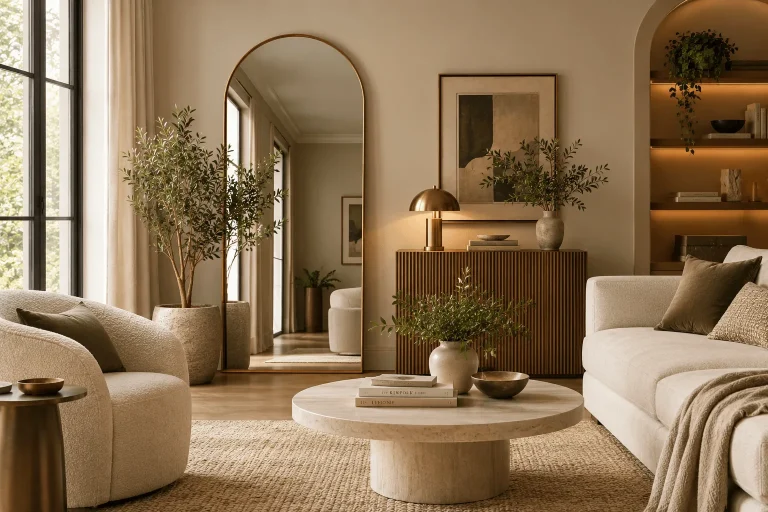
[IMAGE — Bright contemporary living room featuring a large arched mirror reflecting natural daylight]
Alt text: large arched mirror reflecting sunlight in a modern living room with neutral furniture.
Different Styles of Arched Mirrors
Today’s collections include a wide variety of designs suited to different decorating styles.
Minimalist Arched Mirrors
Slim black or brass frames create clean architectural lines that complement contemporary interiors.
These mirrors work particularly well in minimalist and Scandinavian homes.
Wood-Framed Mirrors
Natural oak, walnut and ash frames introduce warmth while reinforcing Organic Modern and rustic-inspired interiors.
The wood softens the mirror’s reflective surface and creates a welcoming atmosphere.
Oversized Floor Mirrors
Large leaning mirrors make dramatic statements while requiring no wall installation.
Placed behind an accent chair or beside a fireplace, they create remarkable visual depth.